
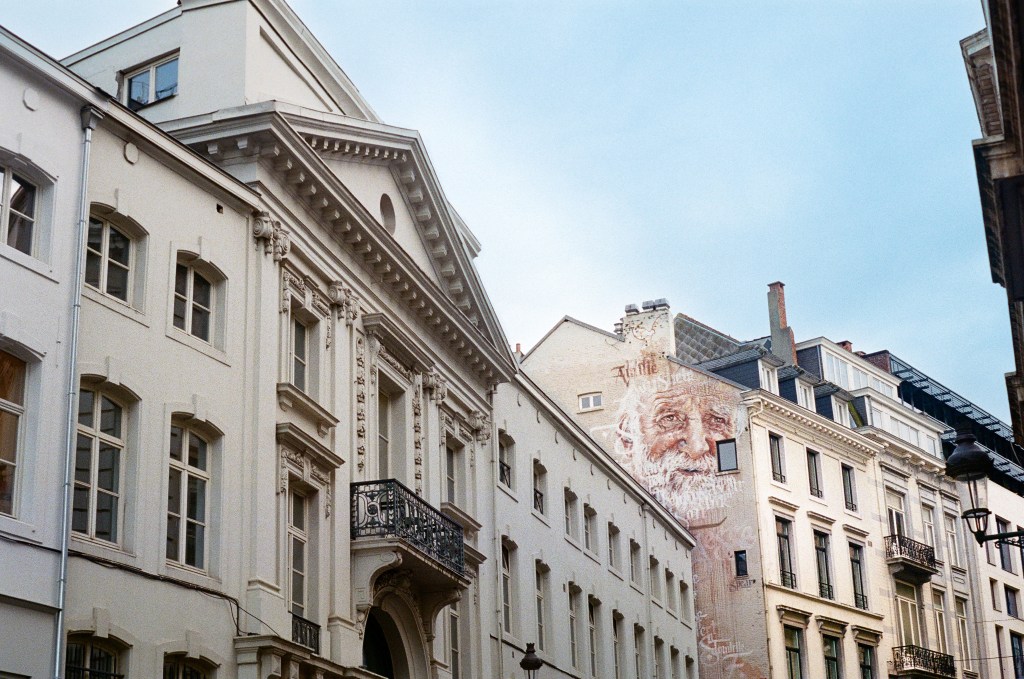
There’s something about stumbling upon artistic expressions in the most unexpected places. On Rue de Namur in Brussels, between luxury boutiques and hurried commuters, an elderly man’s serene face gazes down from a building wall with the kind of contemplative expression that makes you pause mid-step. This isn’t just any graffiti. This is “Sagesse” (Wisdom), a piece of art that to me, represents everything powerful about contemporary graffiti culture.
When Street Art Becomes Street Wisdom
In 2015, Belgian artist Spear transformed a simple, white Brussels wall into something extraordinary. The massive portrait, rendered in warm sepia tones against the classical European architecture, capturing an unnamed sage whose weathered features imply a world of centuries of knowledge. This mural to me is a testament to how graffiti can be used to evoke powerful messages, re-contextualising the environments in which they are placed, whilst telling all kinds of stories to passers by.
The face gazing down from that Brussels building embodies what modern graffiti culture achieves at its finest: the democratisation of art, philosophy, and human connection. Where traditional galleries require admission fees and intimidating white-walled spaces, street art meets people in their local environments. Every day, hundreds of shoppers, tourists, and locals encounter this portrait of wisdom simply by existing in their city.
This is the revolutionary power of graffiti culture: it refuses to be confined, categorised, or commodified in traditional ways. Instead, it inserts beauty, meaning, and reflection directly into the fabric of urban life.
The Artist’s Journey: From Underground to Understanding
Spear’s story exemplifies the global nature of contemporary graffiti culture. This isn’t an artist working in isolation, but someone whose vision has been shaped by travels across continents. Through his work in Argentina, Mexico, Berlin, and London, Spear has absorbed diverse social realities and artistic traditions, bringing this global perspective back to Brussels streets.
In the vibrant world of street art, Corentin “Spear” Binard stands out not just for his monumental murals but for the profound social messages embedded within every stroke. Born in Brussels in 1988, Spear has been transforming urban canvases since 2002, bringing a unique blend of artistic skill and deep human empathy to the streets.
While firmly based in Brussels, where his impactful “Sagesse” mural graces Rue de Namur, Spear’s artistic footprint extends worldwide. His work is a testament to his belief that art can be a powerful tool for social change, making him a true globe-trotter muralist who uses his unique ability to convey deep concerns about real human issues.
This international cross-pollination defines modern graffiti culture. Artists aren’t bound by gallery networks or academic institutions, but are connected through shared spaces, mutual respect for skill, and a common belief that art should be accessible to everyone. When Spear painted “Sagesse,” he wasn’t just creating for Brussels residents but contributing to a global conversation happening on walls from São Paulo to Berlin, from Melbourne to Minneapolis.
The PROPAGANZA collective, which Spear represents, embodies this collaborative spirit. Founded in 2012 to promote graffiti and street art throughout Belgium, the collective brings together thirty diverse artists united by technique, vision, and commitment to public art. This isn’t random tagging, but it’s organised, intentional cultural creation that respects both artistic skill and community impact.
Breaking Down the Barriers: How Graffiti Democratises Culture
Traditional art institutions, for all their cultural value, create barriers. Museum admission fees, intimidating spaces, academic language, and social expectations can make art feel exclusive and elitist. Graffiti culture explodes these boundaries entirely.
Consider “Sagesse” on Rue de Namur. Every person walking from the shopping district to Brussels’ museum quarter encounters this meditation on wisdom; not because they chose to visit an exhibition, but because they chose to live their daily lives. The businessman rushing to meetings, the tourist exploring cobblestone streets, the local resident running errands are all equally welcome to interpret and be moved by this art.
This accessibility transforms viewers into participants. Unlike museum pieces behind protective glass, street art invites personal interaction. The weathered sage on Rue de Namur might remind one viewer of their grandfather, inspire another to consider their life choices, or simply provide a moment of beauty in an otherwise routine day. Each encounter is unique, unmediated, and authentic.
I find that graffiti often helps to add an extra dimension of narrative to street photography. Sometimes it helps to cut away from ambiguity and force a narrative into a scene, or it can help to amplify an overall emotion or atmosphere.
The Evolution of Graffiti: From Rebellion to Recognition
Culturally recognised graffiti helps to amplify the expanse of its reach. Brussels’ decision to allocate €100,000 annually for street art projects represents more than municipal aesthetics: It acknowledges that graffiti culture provides something traditional art channels cannot.
When the Brussels Minister of Culture funded the Rue de Namur project, including “Sagesse” alongside six other works, they recognised need for reflection, beauty, and human connection within everyday spaces. The initiative’s goal of connecting Brussels’ upper and lower districts through art acknowledges that graffiti can heal urban divisions and create shared experiences across social boundaries.
I believe that institutional recognition of graffiti is monumental in expressing a government’s connection to their people’s culture. It doesn’t sanitise graffiti’s rebellious spirit, but instead, it channels that energy toward community building. The raw creativity that once challenged authority now challenges indifference. The techniques remain the same, but the canvas has expanded to include entire neighbourhoods and cultural conversations.
While “Sagesse” offers contemplative beauty, graffiti culture encompasses much broader social engagement. Street artists worldwide address inequality, environmental crisis, political corruption, social justice, and human rights, which are typically topics that traditional art institutions might approach more cautiously.
This willingness to tackle difficult subjects reflects graffiti culture’s outsider origins and democratic values. Without gallery owners, curators, or institutional funding to please, street artists can address urgent social issues directly and immediately. When communities face challenges, graffiti artists more often respond faster than official cultural institutions.
The collaborative nature of projects like the Rue de Namur initiative demonstrates how graffiti culture builds connections across differences. Seven artists with distinct styles and perspectives united to transform a single street, creating aesthetic diversity while maintaining thematic coherence. A beautiful display of cooperation within urban communities to address complex social challenges.
Global Movement, Local Impact
Graffiti culture operates as a global language with local dialects. While techniques, styles, and values transfer internationally, each work responds to specific community needs and cultural contexts. “Sagesse” speaks universally about wisdom while addressing Brussels’ particular identity as a multicultural European capital where diverse traditions converge.
This glocal approach (thinking globally while acting locally) defines contemporary graffiti culture’s social impact. Artists like Spear bring international perspectives to local walls, creating works that resonate with immediate neighbours while contributing to worldwide artistic conversations. The elderly sage on Rue de Namur might remind viewers of Gandhi, Confucius, their own grandparents, or simply the universal human aspiration toward wisdom.
Cities worldwide are recognising this cultural value through various works such as: Melbourne’s famous laneways to Berlin’s East Side Gallery, Mexico City’s commissioned murals and London’s Banksy trails. Municipalities understand that graffiti culture attracts tourism, builds community pride, and creates distinctive urban identities that generic architecture cannot achieve.
Why Graffiti Culture Matters Now More Than Ever
In our increasingly digital, divided, and disconnected world, graffiti culture provides something essential: authentic human expression in shared physical space. While we spend increasing time in virtual environments, street art insists that real walls, real neighbourhoods, and real communities matter.
Graffiti culture also models inclusive creativity. Unlike traditional art education that requires expensive training and institutional access, street art welcomes anyone willing to learn, practice, and contribute to community dialogue. This democratic approach to cultural creation offers hope in societies struggling with inequality and exclusion.
The Lasting Impact of a Single Gaze
Years after its creation, “Sagesse” continues transforming Rue de Namur from a simple transit route into a space for reflection. Commuters pause, tourists photograph, and locals develop personal relationships with the wise face that watches over their daily journeys.
Graffitti creates lasting emotional and intellectual connections between art, place, and community.
In a world that often feels fragmented and superficial, graffiti culture insists that beauty and wisdom belong everywhere, especially on the walls where real people live real lives. The weathered gaze watching over Brussels proves that sometimes the most transformative art isn’t hanging in museums but painted on the buildings where we walk and wonder about what makes existence worthwhile.

 Portraits of Bristol
Leave a comment