
In a world obsessed with bigger, faster, and more efficient, a humble fishing boat reminds us that sometimes the smallest vessels carry the greatest wisdom
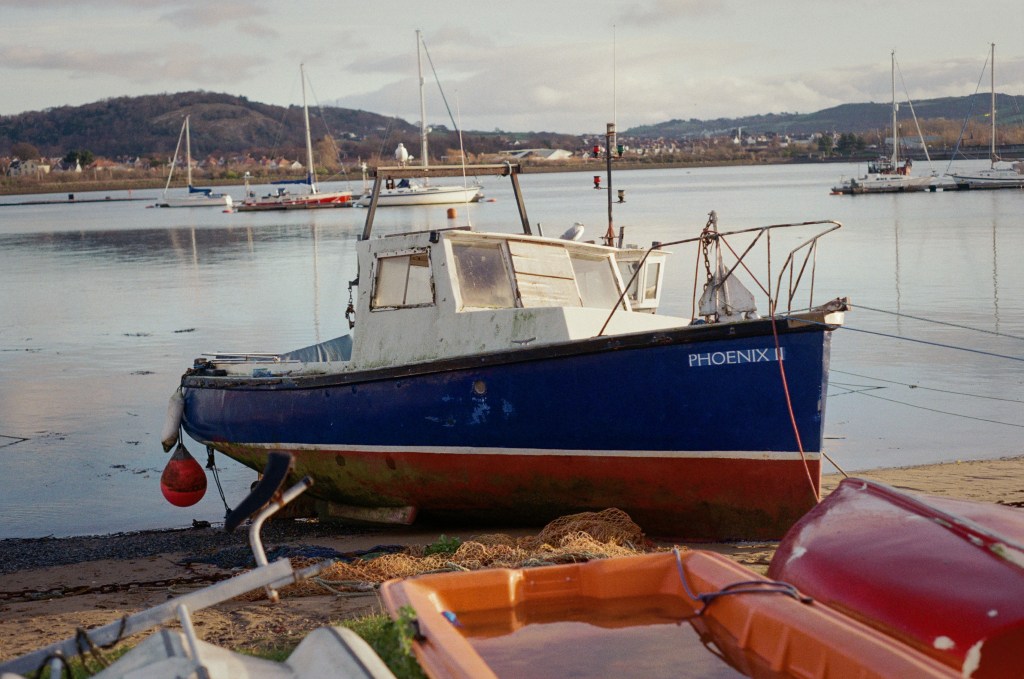
Phoenix II sits modestly at Conwy Quay, her weathered blue and white hull enriched by the warm tones of the sun’s gaze. She’s not impressive by modern standards… no gleaming steel, no towering superstructure, no industrial-scale nets or hydraulic winches. Just a simple working boat with honest lines and humble purpose. Yet in her very ordinariness lies something extraordinary: she represents a way of harvesting the sea that industrial fishing has forgotten, and the world desperately needs to remember.
The Quiet Revolution of Small Things
Look closely at Phoenix II and you’ll notice what she doesn’t have. No massive dredging equipment that tears across the seabed. No factory-ship processing capabilities. No GPS-guided efficiency that can strip-mine the ocean floor. Instead, she carries something far more valuable: the tools and knowledge for hand-raking Conwy mussels, a method so gentle and sustainable it has operated successfully for over 700 years while industrial fisheries around the world collapse under their own unsustainable weight.
This humble boat embodies a profound truth that modern industry struggles to accept: sometimes the smallest approach yields the greatest results.
The Phoenix II lays beached on Conwy Quay, an area most renowned for being the area in which the last wild mussel bed in the UK resides. Mussels here are hand-raked from where they naturally form on the seabed, using traditional methods that are tranquil to watch and devastatingly effective at maintaining the very resources they depend upon.
While industrial mussel farming relies on rope cultivation systems and mechanical dredges that can process thousands of tons rapidly, the humble hand-rake aboard modest river boats (some even smaller than Phoenix II) does something those industrial methods cannot: It naturally selects only mature mussels while preserving the breeding population and ecosystem health.
The methodical, hand-raking method means that smaller mussels which are not mature enough to harvest yet fall through the gaps in the rake. This is a more deliberate form of natural natural resource management that ensures sustainability while producing mussels that are larger in size, meatier and have a distinctive taste that rope grown mussels just don’t possess.
The contrast couldn’t be starker. Industrial dredging is like using a bulldozer in a garden. It’s effective in the short term, devastating in the long term. Hand-raking from small boats is like careful gardening. It’s slower, and maybe more labor-intensive, but ultimately, It’s more productive and infinitely more sustainable.
The Heritage of Humble Excellence
The Conwy mussel trade proves that heritage methods aren’t just museum pieces but they’re the way forward for a sustainable future. This gentle, traditional method allows the mussel beds to recover which ensures that they are retained for the next generations. The technique has been so successful that Conwy mussels achieved Protected Designation of Origin (PDO) status in December 2020, joining the ranks of the world’s most celebrated regional specialties.
This recognition wasn’t given for historical curiosity but for practical excellence. PDO status acknowledges that the combination of traditional hand-raking methods, the unique Conwy estuary environment, and generations of accumulated knowledge creates a product that industrial alternatives simply cannot match.
Small Boats, Big Impact
Industrial fishing fleets tend to struggle with sustainability, profitability, and quality because modern industrial thinking assumes that bigger is more efficient, and technology always trumps tradition. Whereas, the humble boats of Conwy quietly demonstrate solutions to all three challenges.

The River Conwy is routinely monitored for quality by the Environment Agency and is recognised as one of the cleanest rivers in Europe, partly because the gentle harvesting methods actually support rather than degrade the ecosystem. It is such that these small boats embody what economists call “appropriate technology”.
Tools and methods are scaled to their purpose, sustainable in their impact, and elegant in their simplicity. Small boats are able to work these waters for decades without depleting them, while industrial vessels exhaust fishing grounds in years.
Lessons from the Quay
As we look at Phoenix II basking peacefully at Conwy Quay, we’re seeing more than just a fishing boat, but a rebuke to industrial hubris. Her modest proportions and traditional design represent principles that sustainable food production desperately needs to rediscover. Most namely, a respect for natural cycles: Working with tides and seasons rather than against them and to, and an appropriate scale: Tools sized to the task, not to abstract efficiency metrics .
Remember that the smallest boats sometimes carry the biggest lessons, and that sustainable abundance often comes not from conquering nature, but from learning to work with it as these modest vessels do quietly, persistently, and with deep respect for the waters that sustain us all.


 Portraits of Bristol
Leave a comment